---
title: "Still more problems"
description: "Models can now reproduce a bug, write a patch, and pass CI. So why are we still not getting production-level code? Six open problems, and the infrastructure work agents can't do for us."
canonical: "https://baz.ai/resources/blog/still-more-problems"
---
# Still more problems
Models can now reproduce a bug, write a patch, and pass CI. So why are we still not getting production-level code? Six open problems, and the infrastructure work agents can't do for us.
By Guy Eisenkot | 2026-11-25
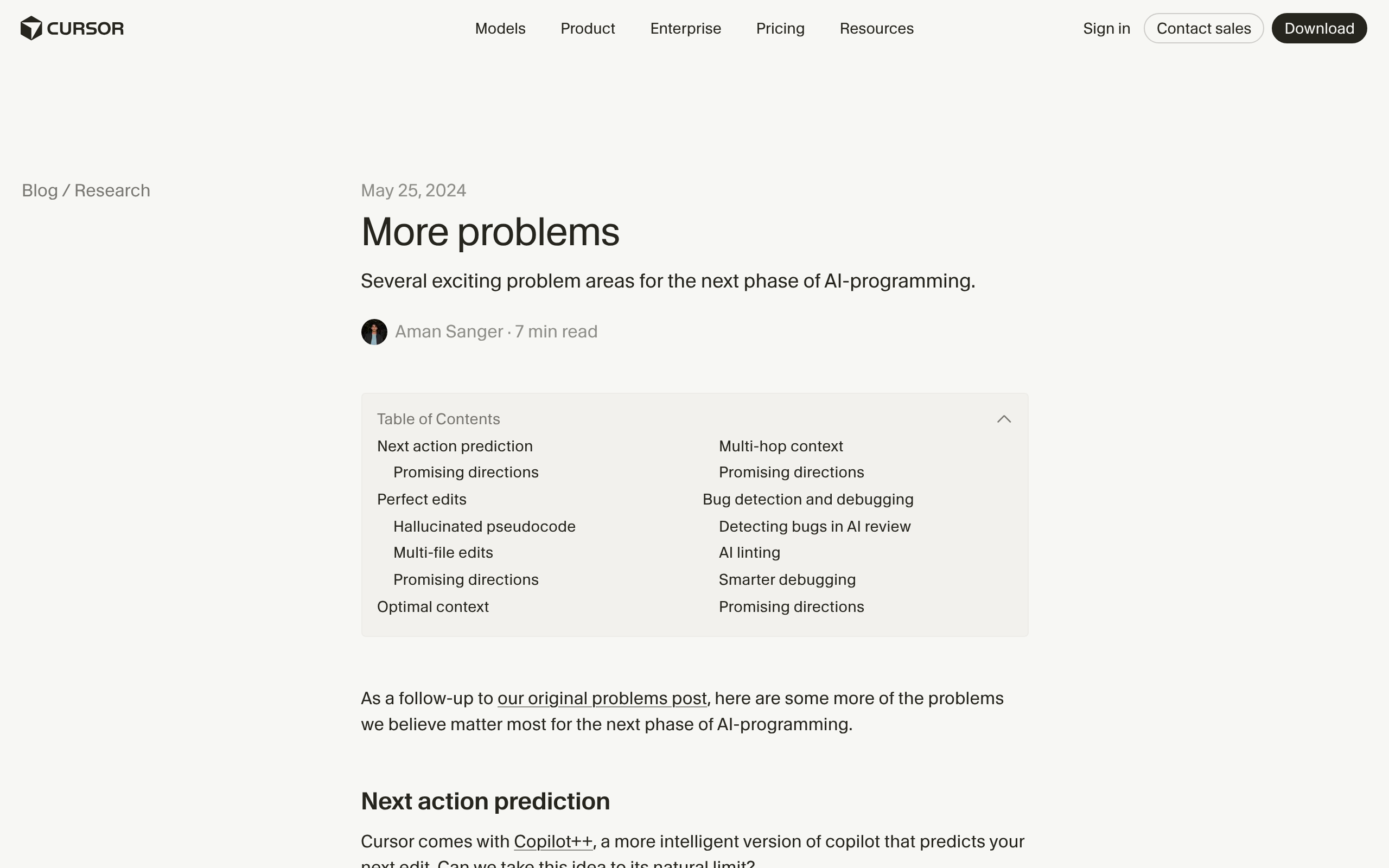
In 2024, Cursor's Aman Sanger wrote [More problems](https://cursor.com/blog/problems-2024), a list of what AI coding still couldn't do. Over the next six months, models knocked those problems down almost in order. I've used his format ever since to sort out what still bothers me about current models.
Aman Sanger's original list on the Cursor blog, May 2024.
In January I wrote about the holes in our infrastructure and why it's [hard to get consistent results](/resources/blog/the-ai-coding-loop-hits-runtime) from agents. Since then, a lot changed. This year we stopped looking up docs, debugging by hand, reading CI logs, and reading every line of every diff. Models like Opus 5.5 can reproduce a bug, pull in the tools they need, and write a patch that passes CI.
And yet we still don't get production-level code, consistently, across the board. Here's why I think that is.
### Intent prediction
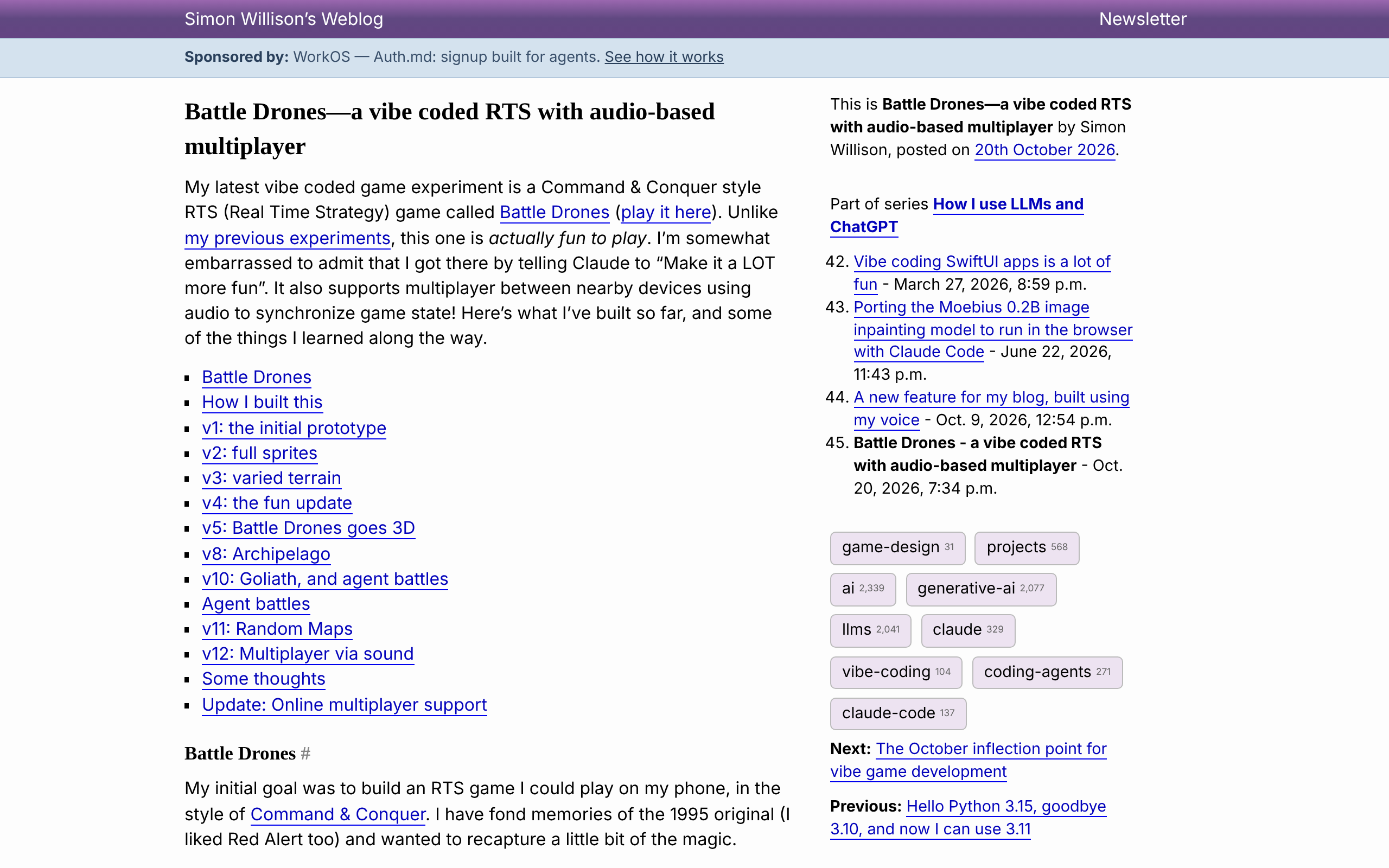
[Simon Willison](https://simonwillison.net/2026/Oct/20/battledrones/) found coding agents reliable enough for daily use back with Opus 4.5 in Claude Code and GPT-5.1 Codex. Opus 5.5 takes much looser instructions. Willison asked it to make his strategy game "a LOT more fun." It ran over a thousand simulated playtests, rebalanced the units, and added new features. Then Willison played the result and decided whether it worked.
Willison's Battle Drones write-up. The agent did the work, and a person made the final call.
That last call came after the code was written. Most product work needs it before. Take a ticket that says "let admins resend an invite." Should the old invite link keep working? An agent can build either answer and write a passing test for it. The test proves the code does what the agent chose. It can't tell you whether the agent chose right.
One engineering team asked us to check every change against two things: the ticket's acceptance criteria, and the existing code outside the diff. You need both to see where a decision is still missing.
**What would help.** Have the agent propose the behavior it plans to test before it edits anything, the way [Planner](/docs/capabilities/planner) puts a [plan up for approval](/resources/blog/approve-the-plan-before-the-code-exists) before code exists. Then measure whether it stops to ask about decisions that affect existing users, and keeps going on choices the team can easily reverse.
### Correct edits
Can more time and better tools give us changes we can trust across a whole codebase? GPT-5.1-Codex-Max learned to compact its own context so it could keep working past a single context window, and OpenAI reported internal runs lasting more than 24 hours. On [FrontierSWE v2](https://epoch.ai/benchmarks/frontierswe), agents get up to 20 hours on each of 34 tasks, one of which is reimplementing Git in Zig. The best model scores about 70%.
Those are real gains, but a benchmark grades an agent against criteria someone wrote down. Shipping adds constraints nobody wrote down: what else depends on this code, what has to keep working, and what breaks halfway through a rollout. The agent has to discover those on its own. Neither a benchmark nor a green CI run checks for them.
### Changes across repos
Picture two pull requests. One changes a contract in a producer service. The other updates a consumer to match. Run them together and both pass. Now ask what happens if the producer deploys first, or if the consumer rolls back on its own.
{% chart id="still-more-problems-version-matrix" %}
We've talked about this at Baz as a context problem. Even when an agent finds the related change in the other repo, it also needs to know which versions can be live at the same time. That's the part [cross-repo context](/resources/research/improving-cross-repo-context-for-baz-code-reviewers) has to carry.
**What would help.** Test every pair of versions that can coexist during a rollout and a rollback. Give agents the architecture decisions that matter, and compare their changes across several PRs. Then ask the harder question: can parallel agents extend the same feature without each one inventing its own competing abstraction?
### Context at merge time
#### Following the path outside the diff
Baz once missed a change that put an embedding job behind an override meant for manual and internal runs. A developer could run the job by hand and see it work. Meanwhile, the normal production path would stop running it for every customer who had turned the feature on.
{% chart id="still-more-problems-path-outside-diff" %}
The path that mattered ran from the changed condition, to the job's caller, to the production flag configuration. Only the first step was in the diff.
Context works in the other direction too: it can rule a bug out. In another review, Baz flagged two issues that depended on an unchanged helper receiving stale data, or data from the wrong source. The helper's only caller passed fresh data from the right place. Those findings still cost the team a second PR and two rounds of human review before they closed them.
#### Approving the right revision
On [Opik PR #9620](https://github.com/comet-ml/opik/pull/9620), a QA bot found tests for both sides of a UI change. Clicking an experiment name should navigate. Clicking its selection checkbox should leave the user where they are. On the same PR, Baz was still waiting for CI and review, even though the developer said the run had finished more than an hour earlier.
Finding the right test is one job. Reading its result on the exact commit you're about to merge is another. A reviewer has to do both.
**What would help.** Require every review finding to show how a real caller reaches the failure. Bind every approval to the revision, the test run, and the rules that applied. [Merger](/docs/capabilities/merge-automation) already ties each verdict to the exact commit it read, and the rest belongs in the same record. Then measure whether those checks catch more regressions without sending engineers through extra rounds of CI.
### Verification in production
#### Giving agents something to observe
When Claude Fable 5 investigated a Safari display bug, it built a reproduction page, captured screenshots from a real browser window, and set up a local server to collect measurements. The session then switched to Opus, which used that evidence to find and verify the fix. That's an agent working the way a good engineer does, with something real to look at.
Can an agent do the same for a production change, where it may see only a small sample of the requests that matter? After a Baz rollback from GPT-6.1 Terra to GPT-5.6 Terra, the affected services emitted 8,701 traces. None were tagged with either model, and there were zero matching errors before or after. So the first check couldn't confirm the rollback at all. Confirming it needed one request on the affected path, and a trace showing which model handled it.
**What would help.** Before merge, have the agent write down the production signal it expects. After deploy, give it enough telemetry to tell whether the affected path ran, whether the behavior changed as expected, and whether to keep going or hand the decision to the on-call engineer. That's the loop our [AI SRE](/product/sre) closes for errors it reads from [Datadog](/docs/basics/integrations/datadog), Sentry, or Coralogix, and the one [sandboxed application review](/docs/capabilities/sandboxed-application-review) opens before merge by running the change in an isolated environment.
### Verification and security
Every problem above ends in the same place. An agent can produce an answer quickly. What's missing is proof that the answer is right for this codebase, this revision, and this production environment.
That's why we split review into two jobs in the Baz [verification protocol](/product/verification). Agents propose concerns, and a separate verifier has to confirm each one with evidence before it reaches the pull request. Requirements from the ticket and the design go through the same check, against the code and against the running application.
{% chart id="still-more-problems-verification-gate" %}
Security is where the gap costs the most. A false positive burns a review round. A missed finding can become an incident. So our [security agents](/product/security) investigate each change at the commit that will merge, and post only what they can show is reachable. The [Secure AI Code docs](/docs/capabilities/secure-ai-code) cover how that works, and [Advanced Security Reviewer](/resources/blog/advanced-security-reviewer-security-review-for-the-cyber-capable-model-era) explains why cyber-capable models raised the bar. Every run leaves a [session record](/docs/capabilities/sessions), so you can check the evidence yourself.
### Infrastructure the agent can't fix
Some of these problems won't be solved by a better model. They're infrastructure problems, and someone has to build the answers. Please work on them.
A coding agent needs infrastructure that can grant access, reproduce failures, and recover from interruptions as the work changes shape. GitHub Actions and AWS mostly expose those controls per job, per workload, or per resource. That's coarser than what an agent actually does.
1. **Network: allow the request, not just the host.** An agent discovers what it needs to reach as it works. Amazon VPC security groups allow traffic by destination, protocol, and port. They can't tell a schema lookup apart from an unrelated upload over the same HTTPS connection.
2. **Network: reach private services across teams.** A reproduction may need private services owned by several teams. AWS PrivateLink provides private connectivity to specific endpoints, but the agent still needs a way to find the right environment and request access to it.
3. **Identity: separate investigating from shipping.** The authority to investigate a change is not the authority to ship it. GitHub Actions OIDC establishes which workflow is requesting an AWS role. Something else has to tie an approval to the exact operation and artifact.
4. **Identity: delegate one task, not every permission.** AWS IAM can scope roles and sessions. The agent runtime still has to issue narrower credentials when it hands a subtask to another agent or tool.
5. **OS: match the runtime behind the bug.** A passing check means little if the failure depends on a different runtime. A GitHub-hosted runner gives you a clean environment, but its image won't recreate the production kernel, native libraries, flags, or data behind the bug.
6. **OS: survive the loss of a worker.** GitHub Actions can rerun a job. A rerun doesn't restore running processes, open connections, or the agent's place in the investigation.
7. **OS: account for what changed during the check.** A GitHub Actions step reports success when a command exits. That status can't show whether setup changed a fixture, or whether the patch weakened an assertion.
8. **Virtualization: isolate parallel experiments.** AWS Fargate isolates tasks at runtime. Two tasks can still interfere if both write to the same database, queue, or preview environment.
9. **Virtualization: rewind external writes.** An Amazon EBS snapshot can restore a disk. It can't undo a migration on a remote database, or take back a deployment request the agent already sent.
10. **Virtualization: rebuild the versions that will coexist.** Amazon EC2 can provision the machines. A release check still has to assemble and exercise the old and new binaries, schemas, and configuration that will be live together.
Aman's list took about six months to age. I'd like this one to age faster.